
New article about transmission spectra of the driven, dissipative Rabi model in the USC regime
We present theoretical transmission spectra of a strongly driven, damped, flux qubit coupled to a dissipative resonator in the ultrastrong coupling regime. Such a qubit-oscillator system, described within a dissipative Rabi model, constitutes the building block of superconducting circuit QED platforms. The addition of a strong drive allows one to characterize the system properties and study novel phenomena, leading to a better understanding and control of the qubit-oscillator system. In this work, the calculated transmission of a weak probe field quantifies the response of the qubit, in frequency domain, under the influence of the quantized resonator and of the strong microwave drive.
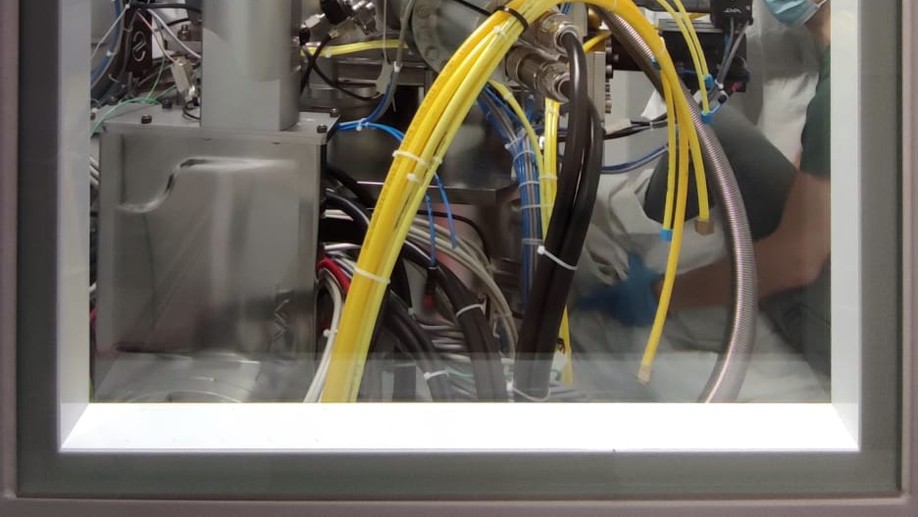
Plassys evaporator installed
This month, we have finally installed our brand-new Plassys evaporator. With it, our lab can be considered completed. We are able to do all the experiment steps in-house: from samples creation, thanks to the Plassys evaporator, to measurement, thanks to our fridge system.
New Post-Doc arrived
This month, Elia Bertoldo started working in our group as post-doc. He completed his bachelor and master in Italy, then he did his PhD at Ludwig Maximilian University (Munich). Welcome aboard, Elia!

XXXII Certamen Jóvenes Investigadores award
High-school student Carla Caro Villanova recently got awarded the first prize of the competition XXXII Certamen Jóvenes Investigadores that is called out annualy by the Spanish Youth Institute (INJUVE). The prize rewards excellence in the scientific projects of Spanish high-school students nationwide. Carla indepdentently conducted her research project co-supervised by David López-Núñez from our group and presented her work with the tile ‘To what extent do quantum annealing computers outperform classical computers?
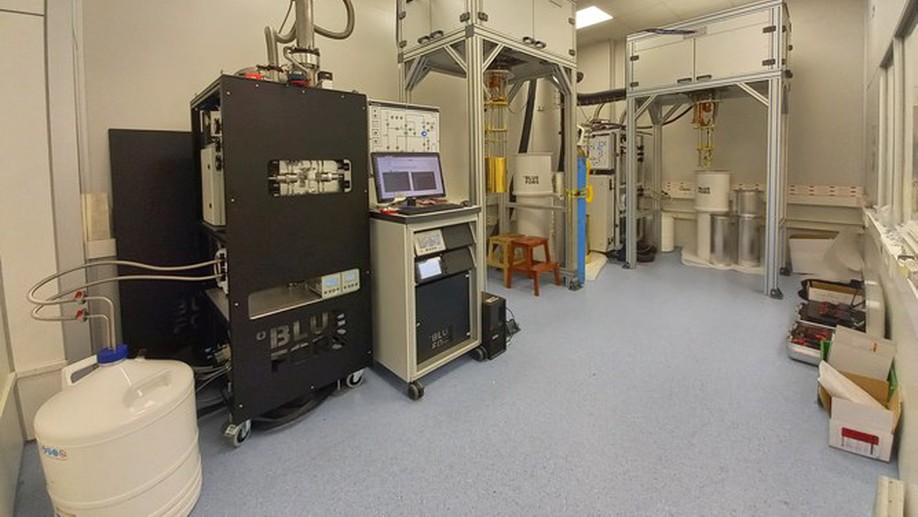
Second dilution refrigerator installed
Since the installation of the first dilution refrigerator did not pass much time. Nonetheless, our group prepared the laboratory for the installation of the second unit, this time the larger BlueFors LD-400 , which was installed succesfully last week. We are now ready to wire up and equip the fridges with our first in-house experiments. For more pictures click here .
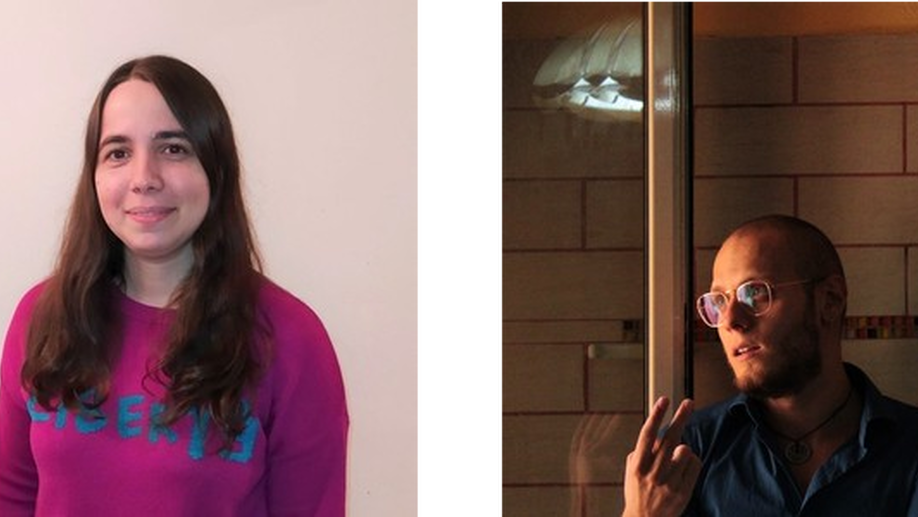
Latest batch of PhD students arrived
This week the latest batch of newcomers arrived and started working in our group. Hence, we welcome aboard Alba Torras and Luca Cozzolino . Both just recently finished their Master’s and will continue to work on a PhD. Alba studied at UAB and UPC while Luca completed his studies at Università degli Studi di Napoli Federico II.
Construction of the new QCT lab completed
We are pleased to announce that the constructions for the new Quantum Computing Lab (QCL) have been completed! After a preliminary phase of planning, a longer than expected phase of construction took place (thanks to Covid19), not missing hands-on work efforts by ourselves. The entire interior of the QCL has been renovated and rebuild to meet our demands and specifications. Andy designed a partition wall for thermal insulation demonstrating Norwegian rigidity and durability.
New PhD student Boris
We welcome the new PhD student and “la Caixa” fellow Boris Nedyalkov to our team. Boris holds a BSc in Physics from Sofia University and recently finished his graduate studies in Electrical Engineering at Tokyo University.
Postdoctoral position on Quantum Annealing
The Quantum Computing Technologies (QCT) group at the Institute for High Energy Physics (IFAE) in Barcelona offers a postdoctoral position within the project AVaQus (Annealing-Based Variational Quantum Processors) funded by the FET Open EU program and coordinated by IFAE . The AVaQus project aims at building a small-scale coherent quantum annealer that is programmable and addresses relevant real-life problems. The project represents an important step towards the consolidation of quantum annealing to become an established quantum computing technology, made in Europe.

PhD position on Quantum Annealing
The Quantum Computing Technologies (QCT) group at the Institute for High Energy Physics (IFAE) in Barcelona offers a PhD position within the project AVaQus (Annealing-Based Variational Quantum Processors) funded by the FET Open EU program and coordinated by IFAE . Project AVaQus aims at building a small-scale coherent quantum annealer that is programmable and addresses relevant real-life problems. The project represents an important step towards the consolidation of quantum annealing to become an established quantum computing technology, made in Europe.